

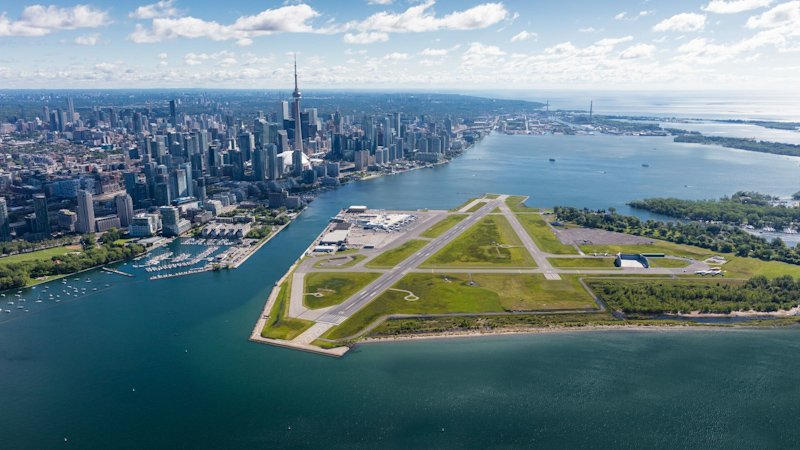
Ontario Premier Backs Billy Bishop Airport Runway Expansion
Ontario Premier Doug Ford has taken a strong stance on the Billy Bishop Airport runway expansion, underscoring the need for jet operations to propel Toronto’s travel sector forward. Addressing the Toronto Region Board of Trade, Ford emphasized mounting public endorsement as indicated by recent government surveys, marking a significant shift in provincial support for the controversial project.
“We have to extend that runway,” Ford declared, underlining the necessity of accommodating smaller jets to diversify passenger travel choices. Situated conveniently in downtown Toronto, Billy Bishop Airport currently operates under limitations that restrict it to turboprop aircraft, a constraint originating from existing agreements that have shaped the airport’s operations for decades.
Current Limitations and Expansion Significance
Today, Billy Bishop Airport features a 3,988-foot runway, predominantly serving De Havilland Dash 8-400 aircraft, operated by Porter Airlines and Air Canada. The facility handles approximately 2.8 million passengers annually, making it Canada’s ninth-busiest airport despite its operational restrictions. The proposed Billy Bishop Airport runway expansion could redefine its operational scope, requiring amendments to the enduring 1983 Tripartite Agreement between the City of Toronto, the federal government, and PortsToronto, which currently prohibits commercial jets and sets a cap on the runway’s length.
The expansion would likely extend the runway to approximately 5,000 feet, enabling operations of modern regional jets such as the Airbus A220 and Embraer E-Jets. These aircraft offer superior fuel efficiency, reduced noise levels compared to older jets, and enhanced passenger comfort while maintaining the airport’s focus on short to medium-haul routes within North America.
Historical Context and Previous Attempts
Past efforts to amend these restrictions have triggered both optimism and resistance within Toronto’s aviation community. Back in 2013, Porter Airlines explored the inclusion of the Airbus A220 (previously known as the Bombardier CSeries) by extending the runway into Lake Ontario. The proposal included significant infrastructure investments and promised to create thousands of jobs while expanding Toronto’s aviation capacity.
However, following the federal government’s decision in 2015 to maintain the existing agreement, citing environmental and community concerns, the plan was shelved. The decision came after extensive public consultations and environmental assessments that highlighted potential impacts on Toronto’s waterfront ecosystem and residential areas surrounding the airport.
Industry and Community Perspectives
Supporters of the Billy Bishop Airport runway expansion argue that accommodating modern regional jets would enhance destination offerings and increase competitive vigor against Toronto Pearson International Airport, which often experiences congestion and delays. The expansion could potentially add 15-20 new destinations across North America, including key business centers like Chicago, Boston, and Washington D.C.
Aviation industry analysts suggest the expansion could generate an additional $2.1 billion in economic activity over the next decade, supporting approximately 8,000 direct and indirect jobs. Porter Airlines has indicated readiness to significantly expand their fleet and route network, potentially positioning Billy Bishop as a premier business travel hub.
Conversely, critics express concerns about potential waterfront encroachment and elevated noise levels, despite modern aircraft being considerably quieter than previous generations. Environmental groups worry about impacts on migratory bird patterns and Lake Ontario’s ecosystem, while some residential communities fear increased air traffic over downtown Toronto neighbourhoods.
Regulatory and Approval Process
Any Billy Bishop Airport runway expansion would necessitate consensus among all Tripartite Agreement parties and the acquisition of comprehensive regulatory approvals, including environmental assessments from Transport Canada and potentially updated zoning permissions from the City of Toronto. The complex approval process, which could take 3-5 years, highlights the conceptual nature of the expansion and the significant hurdles that remain.
Impact on Travelers and Future Outlook
If realized, this expansion could have transformative impacts on travelers. An expanded range of destinations and potential fare competition with Toronto Pearson might offer passengers greater flexibility and cost-effectiveness. Business travelers, in particular, would benefit from the airport’s convenient downtown location and reduced connection times.
However, addressing environmental concerns and gaining community acceptance are essential factors for this major infrastructure project to advance. As stakeholders deliberate on this transformative initiative, Premier Ford’s robust support marks a pivotal shift, potentially setting Billy Bishop Airport on a path toward enhanced functionality and strategic importance within Toronto’s air travel network.
Sources: Toronto Region Board of Trade, PortsToronto, Transport Canada, Porter Airlines

