

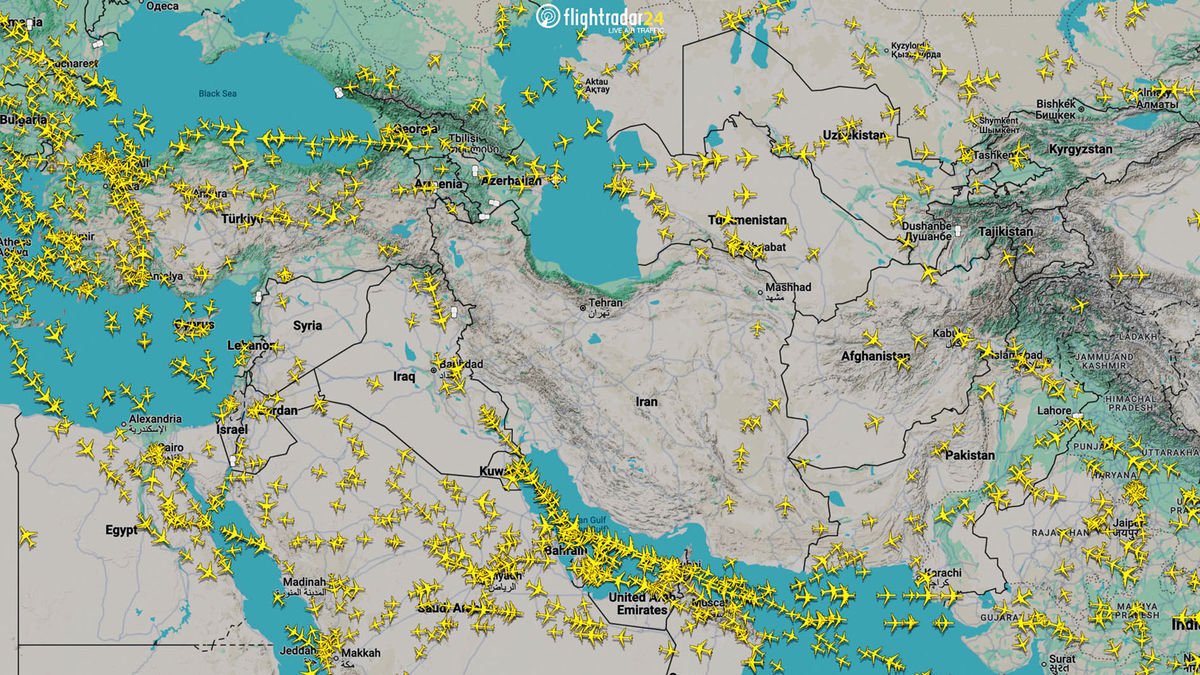
Instability in the Middle East and Eastern Europe has ratcheted up route challenges for global air carriers.
Recent developments in global geopolitics have introduced a series of operational hurdles for airlines worldwide. Despite the cessation of hostilities in Iran in late June, many airlines are finding their flight operations increasingly complicated.
Most air carriers are opting to avoid Iranian airspace, diverting routes either north through Turkey or south via Saudi Arabia and Egypt. These diversions have exacerbated congestion in vital flight corridors that were already under pressure due to the closure of Ukrainian airspace in 2022 and the closure of Russian airspace for Western carriers.
With fewer options available, airlines are frequently compelled to embark on lengthier routes, resulting in reduced scheduling flexibility as they navigate these increasingly crowded skies. “If you’re imagining a six-lane highway, we are now essentially funneling all traffic through two or three lanes,” explained Keith Glatz, senior vice president of international affairs for Airlines for America (A4A).
For U.S. airlines, the restrictions on Iranian airspace date back to January 2020, following tensions that escalated after the U.S. assassination of Iranian general Qasem Soleimani. Although the FAA permits flights over Iraq, U.S. carriers have chosen to avoid that airspace as well, unless flying above 32,000 feet.
The flight risk resource Safe Airspace currently advises against flying over countries such as Iran, Israel, Syria, Lebanon, Russia, and Ukraine, among others. These restrictions have primarily affected routes between the U.S. and destinations like India and China. Due to the closure of Russian airspace, flights to and from China are taking an added two hours, as many carriers must fly south instead of using their usual transpacific routes.
The limitations stemming from the closure of these airspaces have also caused U.S. airlines to largely withdraw from the Indian market. Since 2022, United Airlines has canceled three out of its four India routes, while only American and United operate the remaining routes from New York JFK and Newark to Delhi.
American Airlines has adjusted its JFK-Delhi route to traverse Turkey and remain north of both Iran and Afghanistan before dramatically shifting south toward India. Until recent geopolitical tensions led to the widespread closure of airspaces, Air India utilized a more direct route over northern Scandinavia and Greenland, which could save 30 minutes to an hour in flight time, depending on weather conditions.
However, recent conflicts—specifically the disputed Kashmir issue between India and Pakistan—forced Air India to reroute over Iran, only to find itself again navigating a crowded space following hostilities involving Israel. Presently, Air India is routing through the Saudi Arabia/Egypt corridor, where it competes for airspace with European and Gulf carriers. Some airlines are diverting traffic through eastern Iraq to move between Turkey and the Persian Gulf.
“When you channel a large amount of air traffic through limited corridors, it generates numerous management challenges,” commented industry analyst Bob Mann of R.W. Mann & Co. He noted that this situation restricts airlines’ flexibility in changing routes to optimize for favorable wind conditions, leading to higher operational costs.
Headwinds on Alternate Routes
As Glatz further highlighted, slower airline throughput remains a significant challenge. Airlines might opt to deploy larger aircraft with fewer flights to overcome this issue, but scheduling remains complex and susceptible to disruption. Extended flight durations lead to heightened fuel consumption and complicate crew scheduling, increasing the likelihood of delays and crew duty violations.
These evolving conditions fundamentally alter the economics of many routes. Mann pointed out that high operating costs related to fuel and staff utilization often lead airlines to cancel less viable routes.
Despite the myriad problems posed by airspace restrictions, many airlines are unlikely to swiftly return to operational normalcy over Iran. IATA’s senior vice president for security, Nick Careen, has emphasized past incidents, such as the downing of Ukrainian Airlines Flight PS752 by Iran in 2020 and the recent tragic downing of Azerbaijan Airlines Flight 8243, as stark reminders of the very real risks involved in conflict zones.
Even if regulators do not impose restrictions, airlines are still obligated to conduct thorough operational risk assessments, underscoring the critical nature of safety in their flight planning and decision-making processes.

